
History
Ancient history and settlement.
Main article: History of Dubai § Early Age. The first Dubaians left a sparse record of ancient mangrove swamp remnants and early bronze tool artifacts.
Their earliest coastal fishing and pearling villages relied on palm fronds, mud bricks, and coral stone, materials highly vulnerable to the harsh weathering and shifting sands of the arid desert climate. However, as trade networks expanded across the Arabian Gulf, local rulers began building fortified mud-walled watchtowers and defensive forts to secure vital maritime trade routes. Moreover, early tribal leaders governed nomadic Bedouin and coastal merchant families, but their growing regional influence and deep Islamic heritage ultimately required the construction of enduring stone mosques, bustling central souqs, and sprawling defensive palace compounds. Comparative studies of Emirati oral histories and early regional trading logs.

Geography
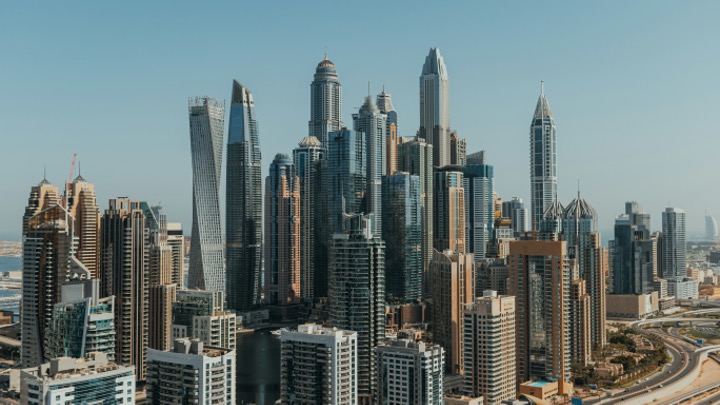
The Dubai consists of a prominent emirate situated on the eastern coast of the Arabian Peninsula, along the northeast-southwest direction, spread over roughly 4,114 square kilometres (1,588 sq mi), making this one of the Middle East’s most rapidly transforming coastal territories. It lies between latitudes 24° and 25°N, and longitudes 54° and 56°E. The terrain is composed of vast rolling sand dunes and flat desert plains that merge into the salt flats of the coast, situated atop a shallow continental shelf that drops off into the warm waters of the Persian Gulf, augmented by massive man-made island archipelagos that extend out into the sea. Only near the southern end of this natural coral barricade do two open passages permit safe